
Excel - Box and whisker chart

Box and whisker is another chart used in statistics to show distribution of data. Suppose you are a watermelon farmer. You weigh 10 watermelons and the weights are below. Unit of the weight is pound.
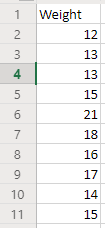
1. Select the data. Then click Insert > Charts > Other Charts. Under Statistical, select Box and Whisker.

 2. You get a box and whisker chart now. The thin line at the bottom shows the minimum. The thin line on top shows the maximum. There is a blue box in the middle. Bottom of the blue box shows 25 percentile of the data. Top of the blue box shows 75 percentile of the data. There is an "X" mark in the middle of the blue box, which shows the median.


3. Suppose we have a super big watermelon which weighs 25 pounds. The data is below. If we make a box and whisker chart again, it displays an outlier because the 25 pound watermelon is way too heavier than other ones. Excel treats any value as an outlier if its value is too much away from other numbers.


Comments

Popular posts from this blog

Excel - Solver examples

Excel Solver is used to solve optimization problems, which is like solving equations. In this tutorial, we will give a very simple example on how to use Excel Solver. Basic example Suppose your car is low on gasoline. The gasoline is $3/gallon. You have a budget of $50. How much gasoline can you buy? Of course, for a problem this simple, we do not even need a Solver to solve the problem. However, the purpose is to teach the users how to use Excel Solver, so we make the problem extremely simple. We have the following framework: Goal: maximize quantity of gasoline Relationship: cost=quantity * unit price Constraint: cost<=budget 1. In cell B1, we enter unit price "3", in cell B4, we enter the budget 50. In cell B2, we just enter an arbitrary number as the number of gallons. We entered 5. In cell B3, we enter the formula "=B1*B2" to let it be the cost, which equals to 15. 2. Click Solver under the Data menu. 3. A Solver dialog window pops up. In "Set objective...

Excel - How to count the number of sign changes (from + to - or vice versa) in a column?

Suppose you have a column of numbers and the data can be positive or negative. How do you count the number of times the data changes from positive to negative, or vice versa? We will use three functions, SIGN , INT and SUM to solve the problem. First we add a helper column B, name it "sign", then use SIGN function to get its sign. If the data is positive, it returns 1. If the value is negative, it returns -1. The formula is like: =SIGN(A2) Then we add another helper column C, call it "sign change", which checks whether sign of the current value is different from the last value. INT function is used to return the logical value TRUE or FALSE into 1 or 0. At last, at the end of column C, we use a SUM function to sum all the value changes. In this example, the data sign changes for 4 times (-1 to -3, -3 to 4, 2 to -5, and -5 to 6). VBA method Below is the VBA code to achieve it. You need to add a clickable button on the spreadsheet and assign the following code t...

Excel - Convert between mile, kilometer and meter

Excel has a very useful function convert numbers from one measure unit to another, for example, from Fahrenheit to Celsius, or from mile to kilometer. The function is  CONVERT . For example, if we want to convert temperature 1.2 mile to kilometer, how to do it? One way is using the equation: 1 mile = 1.60934 kilometer If you do not know the conversion equation, you can just use the CONVERT function. Since kilometer is not a basic unit in the CONVERT function, you need to convert mile into meter first and then to kilometer. For example: =CONVERT(1.2,"mi","m") will turn mile into meters. If you divided the above number by 1000, you will get kilometer. =CONVERT(1.2,"mi","m")/1000 See the following figure for example. You can also convert kilometer into mile in a similar way. You first need to convert kilometer into meter, then use the CONVERT function. The formula is: =CONVERT(2.35*1000,"m","mi")